June 1, 2016

April 30, 2016
Are Entitlement Programs Creating a Culture of Dependency?
The ISSUE


The debate surrounding whether or not entitlements help or hurt the individuals and collective society they serve is not only based on economic concerns, but moral ones. The morality attached to entitlement spending is entwined with deeply rooted American values touting the importance of individualism and personal responsibility, all of which raise the question, “Do entitlement programs create a culture of dependency”?
YES
 |
| Nicholas Eberstadt, author of A Nation of Takers and douche |
 |
| My personal reaction to Eberstadt |
 |
| William Galston, not an asshole |
William Galston, a former policy
advisor to President Clinton, argues against Eberstadt and his claim that the
growth of entitlement programs, since 1960, has destabilized American
self-reliance, and created a culture of dependency. Galston emphasizes
that Eberstadt’s research fails to present any direct evidence that the growth
of government entitlements has weakened America’s moral character. He further
asserts that Eberstadt’s research fails to tell the whole truth by ignoring entitlements such as tax expenditures,
which disproportionately benefit upper-income families and now constitute more
than $1.1 trillion annually. Galston argues that
contrary to dependence, entitlement
programs create interdependence,
which is the extension of reciprocity found in well-functioning societies
(Galston, 2012).
 |
| Interdependence, did you say? |
Examining America’s need for entitlement programs is
different than examining America’s dependency
on entitlement programs. In terms of need,
Galston cites three long-cycle trends that concern the distribution of
entitlements: America’s aging society, the near-disappearance of pensions and
health insurance for retirees, and the macroeconomic trend reflecting higher costs accompanying lower or stalled incomes. Galston undermines
Eberstadt’s dependency claim by citing
the 2009 PEW Social Mobility Project, which reveals most Americans as
continuing to believe that government entitlement programs are not a substitute
for hard work, ambition, and education (Galston, 2012).
 |
| Add caption |
CONCLUSION
To be entitled to something is not the same as being dependent on it. The real moral problem surrounding the increased need for entitlement programs does not come from low socioeconomic people having dependence, but from the underlying causes that create need for entitlement programs, such as multisystemic oppression of marginalized groups, self-interest and greed from big business, loss of benefits, lower-wages, and increased cost of living. Those who share the perception that the majority of entitlement programs are distributed to the bottom of the socioeconomic latter, while single-handedly draining the economy, and creating dependency, laziness, and a desire for “free stuff” are in blind denial.
 |
| That's right, blind denial, folks. |

April 7, 2016
TRANSGENDER PUBLIC ACCOMMODATIONS BILL

April 7, 2016
Office of Congressman Seth Moulton
21 Front Street
Salem, MA 01970
Dear Congressman Moulton
I write as a concerned citizen regarding
the current inaction toward signing the Transgender Public Accommodations Bill(S735, H1577) into Massachusetts legislation. As a student of social work, I
have a vested interest in the well being of all members of our society.
Additionally, I have gained pertinent knowledge and insight into the struggles
oppressed and marginalized groups face. Transgender folk face numerous
obstacles while integrating into mainstream society; the denial of this bill’s
protections and rights should NOT be one of them.
This bill, which seeks to expand legal
anti-discrimination protections for gay and transgender people by including
public accommodations such as restaurants, lodging and restrooms, MUST BE
PASSED. Discrimination is wrong, and it is an outrage that the dignity and safety
of a person is being disregarded simply because of the failure to enact legal
protections - protections that should exist for EVERY person regardless of
their identity.
According to the 2011 National Transgender
Discrimination Survey, 41 percent of transgender participants (2,644 out of
6,450) had attempted to take their own lives. Sexual assault was the biggest
cause, followed by physical assault, harassment in school, and job loss due to
bias. You can view the summary of this report yourself here: http://endtransdiscrimination.org/PDFs/NTDS_Exec_Summary.pdf
I am disappointed in Governor Charlie
Baker’s lack of support for the transgender community by ignoring S735, H1577,
and I urge my state representative to take action. Let the transgender community
know that you care about their well being, protect this vulnerable group, and
send a message that you support non-discrimination by backing this bill. The
time is now.
Sincerely,
Holly Little Van Straaten
February 2, 2016
THEY WARNED ME, I DIDN'T LISTEN, WE WERE BOTH RIGHT: Reflections On Returning To School As An Adult
Back in 1997, when I graduated from High School, the prevailing advice from guidance counselors everywhere echoed through the walls and into the ears of every young student, “Go to college now or life will get ahead of you… Go to college now, go now… before it’s too late”. At the time, I sort of listened to the advice. I applied to college, but I deferred attending in order to use my life savings to travel (alone) and volunteer overseas. By the time I returned from abroad and entered the classroom, my mind was beaming with distraction from my still lingering adventures. I lacked any attention span for studying, ended up busying myself with outside projects - taking the train everyday into Boston to work in the theatre - and neglecting my school work. I wasn’t ready for college, so I left. As any free spirit might imagine, the years that followed were mostly marvelous. I worked all over the country in the theatre as well as odd jobs, met many wondrous human beings, and lived a fulfilling, improvisational life well suited to youth and naiveté.

Then, after a lot of soul-searching, I decided to commit myself to school, this time for real. Just as I made, what appeared to be, a wise plan for myself and my future (I moved out of state, enrolled in a University, found a place to live, got a job, and organized myself into neat little 5-year plans) the old guidance counselors words of wisdom suddenly came true: life got ahead of me. Two weeks into classes at The University of New Orleans, hurricane Katrina came and destroyed my school, most everything I owned, my bank account, and each and every plan I had so consciously designed for myself. The hurricane swept me back to Massachusetts with nothing but a pair of shoes and a heavy blanket of confusion. Life went by very fast after that.

If It’s Not One Thing, It’s Another
I clung to old habits, returned to the theatre and past jobs, experienced the brutality of financial hardship and the lack of options that go with it. I found myself working just to make ends meet - just as so many Americans do - and school was put on the back burner. There it remained while I worked to pay for rent and food, fell in love and consequently married an immigrant, struggled through the years of infertility that followed, and went through the arduous, yet ultimately the most divine, process of adopting my daughter. School remained on that back burner for nearly ten years until the accumulation of all my life experiences began to make sense for me in the form of returning to school to pursue Social Work.
Now, in my mid-thirties, I have a much greater attention span and find myself learning intensely and enthusiastically in school - I’m on the Dean’s List with straight A’s as a matter of fact. I possess an academic drive I never imagined myself having before, and I owe it all to life getting ahead of me because, even if I didn't know it then, that was when I learned who I wanted to be in the world. I’m grateful for the lessons in privilege and oppression, how they shape a life, and my personal responsibility in acknowledging the many ways I am at an advantage over others. I’m thankful to have experienced the depth of heartache that true disappointment can yield, and even more thankful for the sense of accomplishment that sometimes comes later. Today, I am particularly grateful for the experiences that have taught me the value of an education, and given me a clear vision of myself as a social worker.

Then, after a lot of soul-searching, I decided to commit myself to school, this time for real. Just as I made, what appeared to be, a wise plan for myself and my future (I moved out of state, enrolled in a University, found a place to live, got a job, and organized myself into neat little 5-year plans) the old guidance counselors words of wisdom suddenly came true: life got ahead of me. Two weeks into classes at The University of New Orleans, hurricane Katrina came and destroyed my school, most everything I owned, my bank account, and each and every plan I had so consciously designed for myself. The hurricane swept me back to Massachusetts with nothing but a pair of shoes and a heavy blanket of confusion. Life went by very fast after that.

If It’s Not One Thing, It’s Another
I clung to old habits, returned to the theatre and past jobs, experienced the brutality of financial hardship and the lack of options that go with it. I found myself working just to make ends meet - just as so many Americans do - and school was put on the back burner. There it remained while I worked to pay for rent and food, fell in love and consequently married an immigrant, struggled through the years of infertility that followed, and went through the arduous, yet ultimately the most divine, process of adopting my daughter. School remained on that back burner for nearly ten years until the accumulation of all my life experiences began to make sense for me in the form of returning to school to pursue Social Work.
 |
| artwork by Bread and Puppet Theatre |
Now, in my mid-thirties, I have a much greater attention span and find myself learning intensely and enthusiastically in school - I’m on the Dean’s List with straight A’s as a matter of fact. I possess an academic drive I never imagined myself having before, and I owe it all to life getting ahead of me because, even if I didn't know it then, that was when I learned who I wanted to be in the world. I’m grateful for the lessons in privilege and oppression, how they shape a life, and my personal responsibility in acknowledging the many ways I am at an advantage over others. I’m thankful to have experienced the depth of heartache that true disappointment can yield, and even more thankful for the sense of accomplishment that sometimes comes later. Today, I am particularly grateful for the experiences that have taught me the value of an education, and given me a clear vision of myself as a social worker.
January 22, 2016
REACTING TO EXTRACTION, EXPLOITATION, CONSUMERISM, AND GLOBAL WEALTH INEQUALITY: What FOOLS These Mortals Be
What a nightmare, what total and utter madness!

After carefully viewing both The Story of Stuff and Global Wealth Inequality I’m a little out of breath, honestly - and it’s not the first time. I mean, the subjects relating to our world’s “materials economy” aren’t exactly news to me - I’ve caught wind for some time now. Each reminder, though, of how severe the “system in crisis” is, renders me speechless. But, all it seems I can do is cry. Cry from the surge of anger, despair, pity, and shame I feel from the knowledge of what is being done to our world, the people who inhabit it, our values, and ourselves.
 |
| Materials Economy |
It is one thing to have knowledge - they say knowledge is power - but it doesn’t feel that way. Instead, it feels different from power, it kind of feels like Hell. Hell is knowing that my own pillow is made from neurotoxins poisoning not only me who is sleeping on it, but also the exploited person who made the pillow in the first place. Hell is the knowledge that 99 percent of the “stuff” extracted, transported, and sold is TRASHED within six months - more Hellish is knowing this was the design all along, through planned obsolescence. Hell is knowing the richest 300 people on Earth have as much wealth as the poorest 3 billion and that those 3 billion don’t stand a chance because the rules enforced upon them are designed to keep them powerless. Hell is having the knowledge of the power of corporations, “trade misplacing”, and “trade rules”, but knowing very few others who share the same awareness. Hell is being confronted with the unwillingness of people to even learn about what is happening around them, and knowing it is too much of a mess to clean up without their help.
 |
| Spinning mills in the Indian state of Tamil Nadu supply a number of well-known European and US brands and retailers. |
Probably most Hellish of all is being confronted with my own personal responsibility in the orchestra of consumerism, and owning up to the ignorance and daily indulgences that come at such a high cost for so many others. How could we let this happen? Furthermore, why do we continue to let this happen, especially since we are collectively miserable? Why do we not change the rules? I am looking around every corner of my apartment and taking note of all the plastic children’s toys scattered on the floor. I’m thinking about the small hands that helped make them - far away in a toxic environment - from materials harvested from other far away places. All these meaningless things on the floor feel so much more significant than they did before. I wish I thought about this when I decided to buy them. I wish everyone did.

December 1, 2015
WIND-ROSE


Waiting to be placed with a child through adoption is somewhat like floating in the middle of the sea with a sail all hoisted and ready, but unable to be steered. You go where the wind blows you and trust that somehow you’ll end up where you’re meant to be. But, the winds of the adoption process can also send you astray or floating around in circles (and it often does), testing your hope, forcing you to question whether you are actually lost rather than in waiting. The wind rose is there as a reminder to be patient and trust that soon a new wind will come and another direction will be taken. As I lay floating at sea, solemnly waiting for the wind to guide me to my future child, I knew in my heart that one day I would have a little girl and I would name her Wind-Rose.

We met on Valentine’s Day, my baby girl and I, when she was just two days old. Her father and I arrived at the crack of morning, to a town we’d never heard of before, and a hospital decorated with Valentine roses, love-hearts, and chocolates for sale. We had driven 20 hours straight through the night after receiving a call that a baby girl had been born outside Chicago and the adoptive family-in-waiting had suddenly changed their minds. Just like that, without warning, the wind had shifted and we were swept to shore. We stood in the sterile hallway of a birthing center, holding a splendid baby girl with the most beautiful rose bud lips and no given name. Hours later we sat in the hospital parking lot staring bleary eyed and astounded into the face of our newly found daughter, Wind-Rose. Light snowflakes fell outside.

Wind-Rose, or “Rosie” as she is most frequently called, was the grand marshal of an otherwise sad parade. She was a beaming, beautiful, blessing who headed straight toward me, but behind her there followed a trail of heartbreak. When I set my sights on adoption, I knew that my great joy would inevitably come from someone else’s great loss. I knew that all the wishes I made to finally find a child of my own were also, in some way, wishes for someone’s failure. This made the joy of wrapping her into my arms tinged with bittersweet. Sweet because I was enraptured by her arrival in the way a child is at their very first sighting of Santa Claus atop the finale float of a grandiose parade. Bitter because my daughter was brought into my life from another mother’s arms, a mother who was, in those very moments, surely weeping.

Part of me always feels the presence of this woman, my daughter’s first mother, and the grief she must carry. At times, I feel it is my duty to somehow make up for her sense of loss, but this is an impossible task. Yet, the knowledge of her has also been, for me, a profound guiding light that extends my limits of patience and pleasure while mothering this wonderful child. It is a breathless whisper that follows me saying, “do not take this for granted”. So I don’t.

I laugh often with my child, I love her with bottomless love, I work to better myself so that my daughter’s life will vicariously be bettered, I accept her, adore her, embrace the chaos as temporary, devote my time to her, and I give my all - at least, I aim to. This is not to say any of these acts are unique or go unrecognized by biological mothers. The adoptive mother differs only in that while nurturing her child, she also honors a promise made to the woman who came before her. In this way, how I care for my daughter is also how I care for the woman who trusted me to be her baby’s mother. She, who let me name her child, not knowing that the chosen name, Wind-Rose, was a reflection of her as well - the one who sent the wind to me that day while I waited out at sea. She, who unknowingly saved me.

November 11, 2015
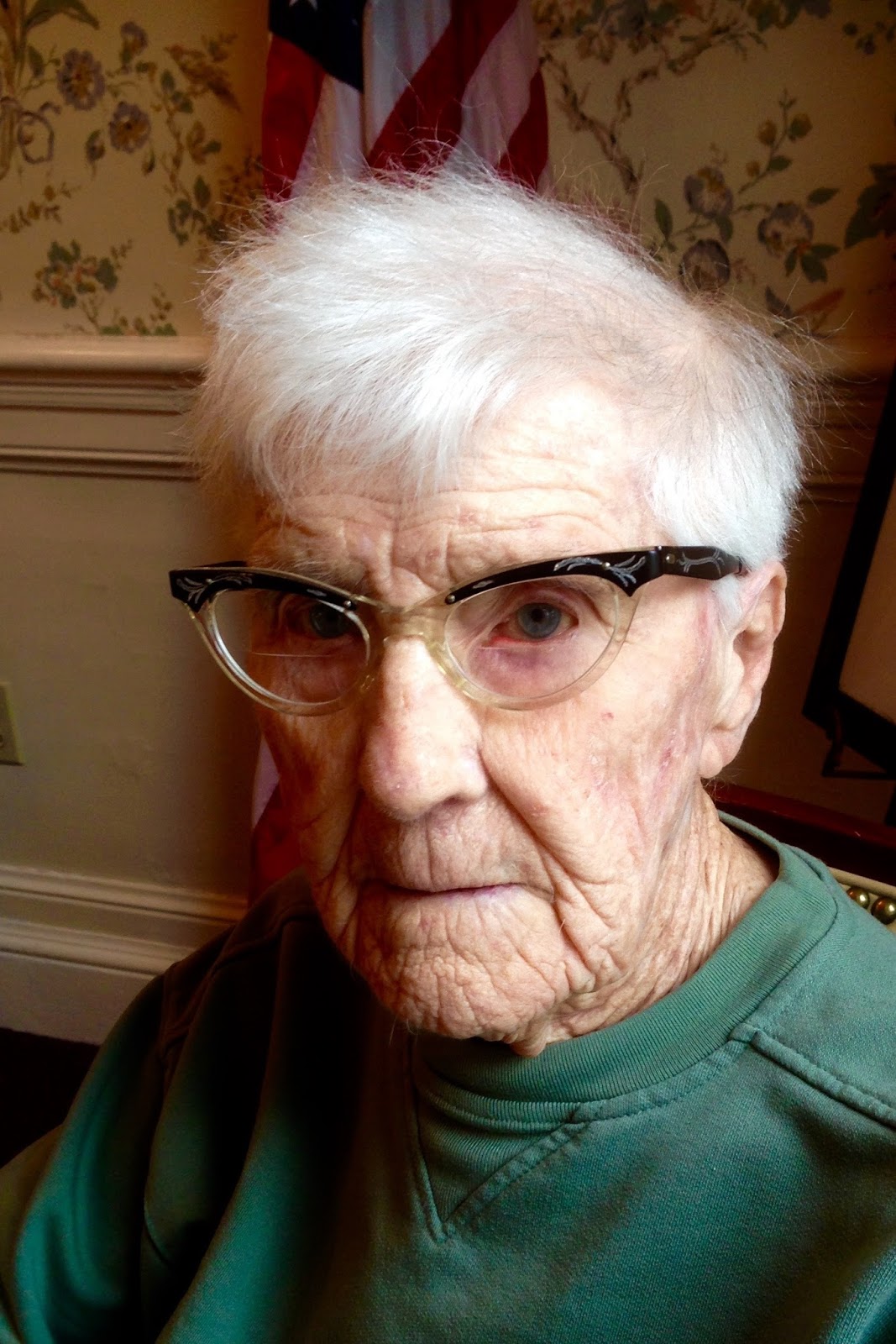
LIL
 |
| Lil |
 |
| Historic Salem MA |
 |
| Pokeno |
 |
| Lil's "chum" Marjorie |
A community setting like the one at the John Bertram House is important to Lil since she not only thrives on social interaction, but also on serving a purpose. Lil has taken many of the elders under her wing. I’ve observed her lovingly assist others throughout the rooms, and interact with the kind of care only a mother would give. She is known to grab a broom in the dining hall, strip the tables of their linens after meals, and clean up the common area even though these are all tasks reserved for staff. Rarely, if ever, does she request assistance for herself. She even opts not to use the elevator, but climbs up and down the stairs each day - carefully grasping both railings as she goes - and walking backward down the stairs to better view her feet.
 |
| John Bertram House |
Lilian, or “Beautiful Lilian” as I called her, was another one of the residents I’ve had the chance to know over the last two months. An elegant, petite woman with perfectly silver hair and impeccable style, Lilian couldn’t speak louder than a whisper, but what she had to say was always as gentle as her voice. She was full of compliments and gratitude, patience, and willingness to engage. She told me about her two daughters, her work as a nurse, and how happy she felt to see me smiling at her. I came to love and adore Lilian in just a short time and now she is gone.
 |
| Lily's last bloom |

Subscribe to:
Posts (Atom)